Can I actually rewrite this PLR content? The most asked question of the last month. Yes, in most cases you can legally use AI to rewrite PLR content. A standard PLR license grants you the right to edit, modify, and rebrand the content you purchased. The license governs what you do to the content, not which tool you use to do it. Whether you rewrite a PLR ebook by hand, hire a ghostwriter, or run it through Claude or ChatGPT, you are exercising the same modification rights.
But that “in most cases” matters. Not all licenses are equal. Some restrict how much you can change, where you can publish, or whether your buyers can resell. And if you are holding MRR content instead of true PLR, the rules flip entirely.
This post walks through what PLR licenses actually say, where AI fits in, and the handful of situations where rewriting could get you into trouble. One note before we start: I am not an attorney, and this is education, not legal advice. When a license leaves you unsure, the vendor is one email away.
Contents
- 1 Key Takeaways
- 2 What Does a Standard PLR License Actually Let You Do?
- 3 What Can't You Do, Even With a Full PLR License?
- 4 Wait, What About MRR Content? Can AI Rewrite That?
- 5 Does Using AI Change the Copyright Picture?
- 6
- 7 How Do You Stay Safe? A Simple Compliance Routine
- 8 Frequently Asked Questions
- 9 Final Thoughts
Key Takeaways
- Standard PLR licenses explicitly grant modification rights, and AI rewriting counts as modification just like manual editing does
- The license controls the content, not the tool. If you are allowed to edit, you are allowed to edit with AI
- MRR (Master Resell Rights) content usually cannot be edited at all, so AI rewriting MRR products can violate the license
- Every vendor writes their own terms. Some restrict marketplaces like Amazon KDP, free distribution, or how the content is resold
- The bigger risk isn't legality, it's laziness: unchanged or barely-spun content hurts your brand and your search visibility either way
What Does a Standard PLR License Actually Let You Do?
PLR stands for Private Label Rights, and the “private label” part is the whole point. You are buying the right to put your own label on the content.
A typical PLR license grants you the right to edit and rebrand the content, which includes rewriting, adding, removing, combining, and even translating it. You can then sell it, give it away as a lead magnet, publish it on your blog, or fold it into courses and memberships, keeping all the revenue.
Notice what that list includes: rewriting. It is not just permitted. Most vendors expect it. Some licenses even require modification before resale, because vendors know that hundreds of buyers purchased the same pack, and nobody wins if identical copies flood the market.
So when someone asks “can I use AI to rewrite my PLR,” the honest answer is that the license already answered the question. If modification is granted, AI is simply the fastest pen you own.
What Can't You Do, Even With a Full PLR License?
Here is where sellers get tripped up. Even the most generous PLR license draws a few firm lines:
You cannot claim the original author's identity. You can publish under your own name after transforming the content, but you cannot sell it under the original creator's name or misrepresent where it came from.
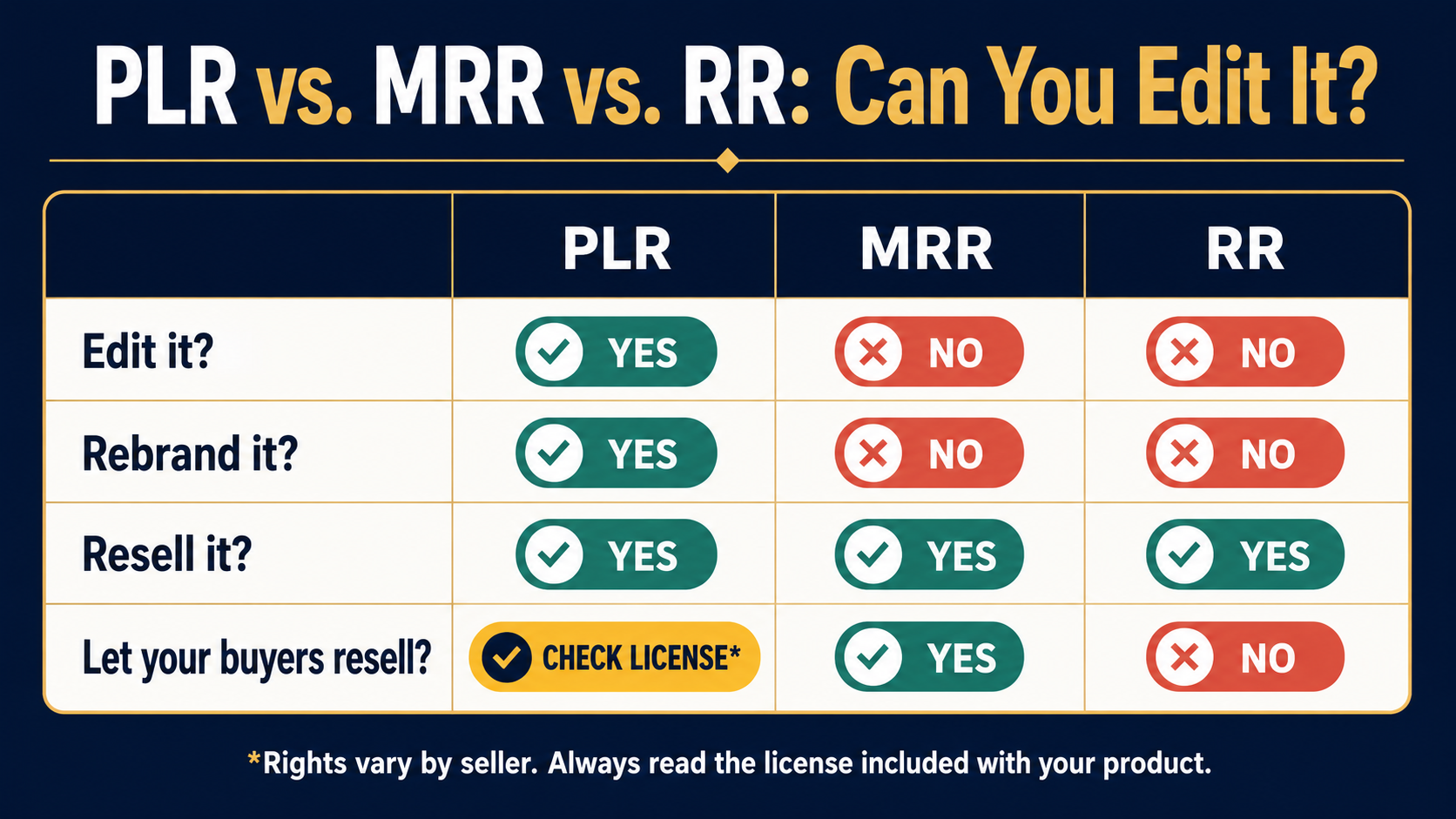
You usually cannot transfer the rights themselves. Most PLR licenses are non-transferable. Your customers typically receive a personal-use license, not the right to resell what you sold them, unless your license specifically allows you to pass along resell rights.
You often cannot resell it completely unchanged. Many licenses prohibit repackaging and reselling without modification. This is exactly where AI rewriting helps you stay compliant rather than putting you at risk.
Some licenses restrict specific platforms. Amazon KDP is the classic example. Amazon requires substantially unique content and can suspend accounts over barely-differentiated material, and many PLR vendors prohibit uploading their content there unchanged.
Wait, What About MRR Content? Can AI Rewrite That?
This is the trap, and it catches a lot of well-meaning sellers.
MRR stands for Master Resell Rights, and it works differently than PLR. With MRR, you can resell the product and even pass resell rights to your buyers, but you usually cannot edit it. The content has to be sold in its original form. Only the original creator holds editing rights.
So if you bought an MRR ebook and ran it through AI to “make it yours,” you may have just violated the license. The tool didn't cause the problem. The license type did.
The fix is simple: know what you are holding before you rewrite anything. If the license says PLR with modification rights, rewrite freely. If it says MRR or RR, sell it as-is or skip it. And if a bundle mixes license types (they often do), sort the files before you touch them.
Does Using AI Change the Copyright Picture?
Here is the nuance worth understanding, explained plainly.
When you rewrite PLR with AI, you are creating what's called a derivative work, and your PLR license is what authorizes you to do that. Your permission comes from the license, not from the AI. That part is clean.
The murkier question is what you own afterward. Purely AI-generated text, with no meaningful human input, generally does not qualify for copyright protection on its own in the US. But that is rarely what a smart PLR seller produces. When you direct the rewrite, restructure the content, add your own stories, examples, and expertise, and edit the output, you are adding human authorship. The more of you in the final product, the stronger your position, both legally and commercially.
And honestly, that is the same advice I would give if AI didn't exist: transformation is what makes PLR valuable. The license makes rewriting legal. Your voice makes it worth buying. So the answer to your question: Can I actually rewrite this legally? Yes, you can legally rewrite this in your tone as long as your license allows it.
How Do You Stay Safe? A Simple Compliance Routine
You do not need a law degree. You need a habit. Here is the routine worth building:
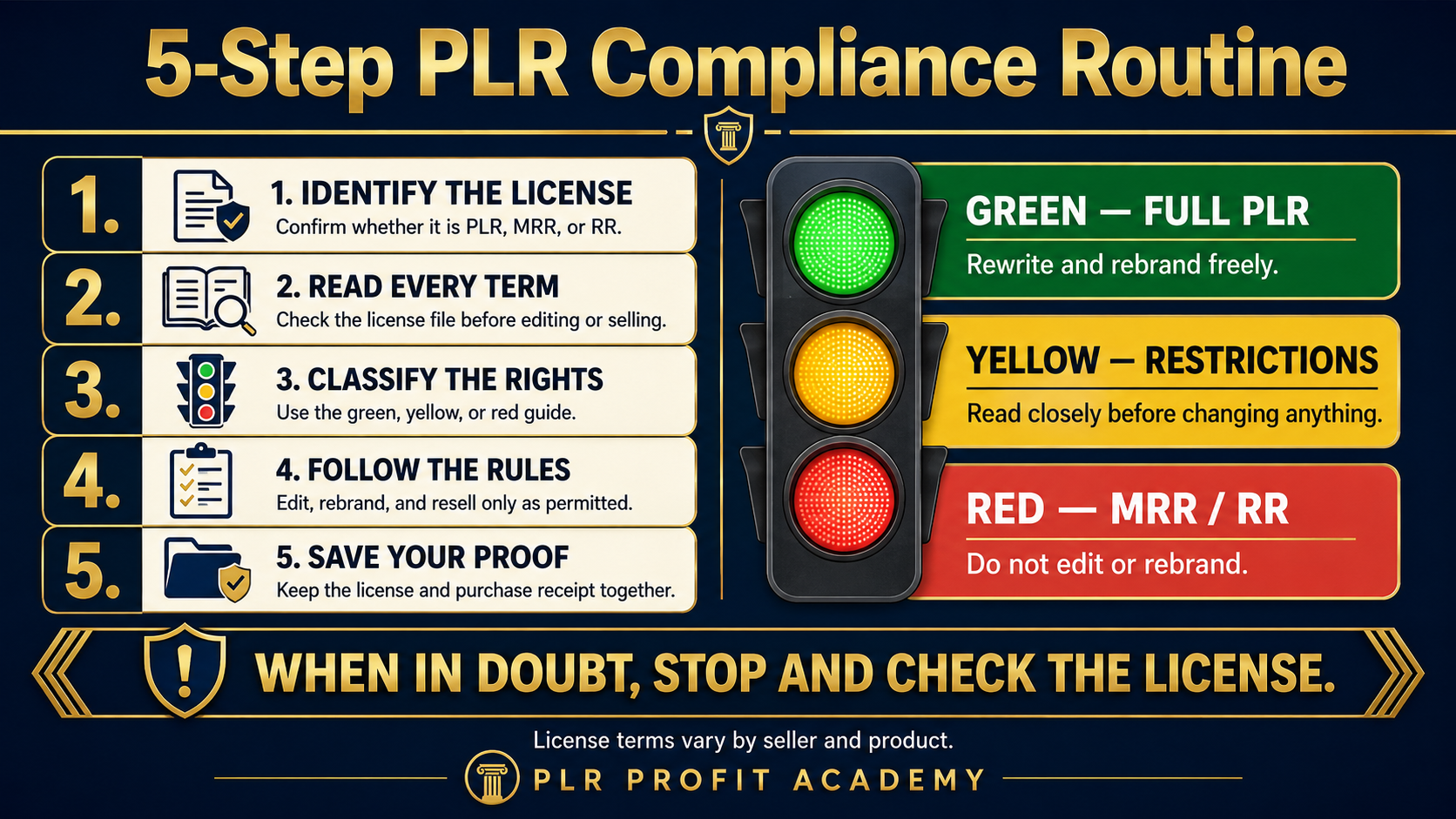
Step 1: Read the license before you buy, and again before you publish. Vendors usually post terms on the sales page or link to them. Some hide unusual restrictions in the fine print, like requiring a rewrite before any resale.
Step 2: Save every license with its product. Keep a folder (or a simple spreadsheet) matching each PLR pack to its license file and purchase receipt. If a question ever comes up, you want proof of what you bought and what it permits.
Step 3: Confirm the license type. PLR, MRR, and RR are not interchangeable. Only rewrite what your license lets you modify.
Step 4: Transform, don't spin. Aim for a rewrite a stranger couldn't match back to the original: new title, new structure, your voice, your examples, updated information. This satisfies stricter licenses, keeps platforms happy, and gives search engines and AI assistants something original to cite.
Step 5: When in doubt, ask the vendor. Reputable PLR sellers answer licensing questions all the time. A two-line email beats a takedown notice every time.
Frequently Asked Questions
Is it legal to use ChatGPT or Claude to rewrite PLR content? In most cases, yes. Standard PLR licenses grant modification rights, and AI rewriting is a form of modification. The license doesn't care whether you edit by hand or with AI. Always confirm your specific license grants editing rights first.
Can I rewrite MRR products with AI? Usually not. Most MRR licenses prohibit editing entirely. The content must be resold in its original form. If you want to rewrite something, buy it with true PLR rights.
Do I have to credit the original PLR creator? No. That is the point of private label rights. You publish under your own brand. What you cannot do is sell it under the original creator's name or claim their identity.
Can my customers resell the content I rewrote from PLR? Only if your license allows you to pass along resell rights, and only if you explicitly grant them in your own product license. By default, assume your buyers get personal use only, and say so clearly on your sales page.
What happens if I resell PLR completely unchanged? Depending on the license, you may be violating its terms. Even when it's technically allowed, you are competing against identical copies, and duplicate content rarely ranks or gets cited by AI search engines. Unchanged PLR is a legal gray zone and a business dead end.
Final Thoughts
The fear around AI and PLR mostly comes from mixing up two separate questions. What you can do with the content is answered by your license. How you do it is up to you, and AI is a perfectly legitimate how.
Read the license. Sort your PLR from your MRR. Transform deeply enough that the final product could only have come from you. Do those three things and AI becomes what it should be: the tool that finally lets you use the PLR library you've been collecting, instead of just admiring it.
And if a license ever leaves you squinting, ask the vendor. The good ones want you to succeed with their content.
Be well. 💛